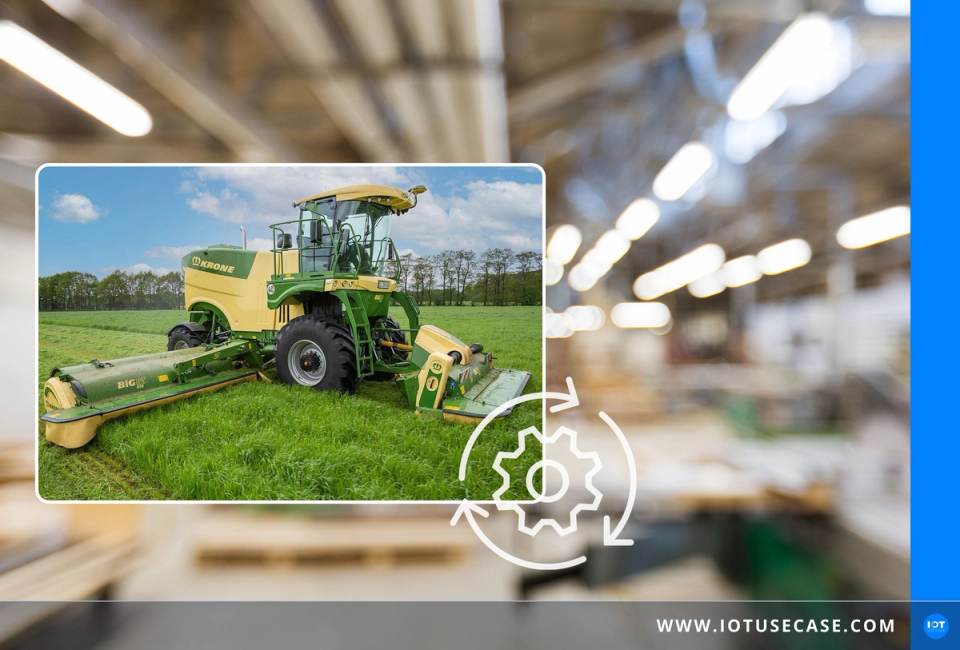


The agricultural machinery manufacturer KRONE is building its new Smart Factory from the ground up. The basis: an event-driven architecture. It ensures that information is processed in near real time. This makes production more efficient, robust and scalable. The biggest challenge? Networking a wide variety of machines and systems. In addition, the factory must be AI-capable and save energy. KRONE developed and successfully implemented this architecture together with Cybus, NTT DATA and the FIR e. V. at RWTH Aachen University.
Challenge: From greenfield to an event-driven Smart Factory
KRONE was facing a major task. A new smart factory was to be created – with state-of-the-art technology and well thought out from the outset. Not an existing factory, not a conversion, but a new start on a greenfield site.
The goal: flexible production that keeps pace with changing requirements. After all, supply chains are fragile today and customer requirements change quickly. Machines and applications from various providers had to be integrated, and ideally, in a way that they can communicate with each other.
„"The IT architecture we have created is nothing less than a revolution. It optimizes production and ultimately transforms our plant into a future-proof and genuine smart factory.""
– Dr. Goy Hinrich Korn, CDO
KRONE therefore opted for a completely new type of factory – a genuine smart factory. It should be reliable, efficient and adaptable. The Greenfield plant of Green Teuto Systemtechnik GmbH in Ibbenbüren is thus becoming a blueprint for future locations. For this to succeed, the architecture must be scalable and easy to roll out. Machines, energy, and AI – everything should work together seamlessly. Challenges included the integration of various machines and the implementation of energy management solutions for ESG compliance. In addition, the smart factory had to support different use cases, automation and AI. Together with Cybus – in close cooperation with NTT DATA and the FIR e. V. at RWTH Aachen University – KRONE took shopfloor management to a new level.
What is an event-driven architecture?
In an event-driven architecture, each production event sends a message to a central system. This notifies other components or triggers actions. This means that changes can be processed quickly. Production scales through autonomous components and failures are better absorbed. Data silos can also be reduced, and complex software rollouts are accelerated.
Solution: A Factory Data Hub that enables the data flow for event-driven Smart Factories
„"Today, we have a data-driven production environment where we can leverage all machine data – because Connectware gives us access to all industrial data. This enables us to implement any use case, such as predictive maintenance.""
– Pia Brüggemann, Entwicklerin
KRONE integrates data systems, machine learning and AI for optimized IT and manufacturing efficiency and scalability Cybus Connectware is a Factory Data Hub that serves as a central data infrastructure, enabling seamless data flow between all machines and applications – while providing scalable data integration. Connectware acts as a local event broker, standardizing data from heterogeneous machine environments and making it usable for IT. Together with NTT DATA and FIR e. V. at RWTH Aachen University, KRONE and Cybus developed and implemented a scalable, event-driven architecture.
NTT DATA led the design and implementation of the IT architecture, based on an initial requirements specification. This involved defining the use cases through Design Thinking and selecting the most suitable applications. A key focus was the seamless integration of machines, peripheral systems, and global IT infrastructures. Cybus, in collaboration with NTT DATA, developed the integration logic for production data based on Connectware. The Factory Data Hub was used for the first time and enhanced with Apache-based streaming components for real-time analytics. FIR e. V. at RWTH Aachen provided methodological support with expertise in production and industrial processes.
Three key building blocks for digital factory processes
Understanding the language of any machine
Connectware acts as a data translator, enabling seamless integration between Industrial IoT, AI and IT systems. For unique machine protocols, KRONE can quickly create custom connectors using Connectware’s Protocol Mapper.
Data integration at scale
KRONE deploys large configurations using Connectware’s infrastructure-as-code approach. This allows KRONE to standardize use case descriptions into a single structured text file, aligned with Industrial DevOps practices, enabling rollouts across multiple factories.
Complying with environmental, social and governance (ESG) guidelines
KRONE improves occupational safety through data-supported monitoring of environmental conditions and pollutants. At the same time, energy efficiency is promoted by analyzing real-time energy consumption.
The result: Connected production, automated processes, enhanced safety
KRONE now benefits from a connected production environment where customer orders are processed faster, more accurately, and with minimal manual effort – while also improving workplace safety and achieving a lead time of just twelve months from greenfield to production start.
In just twelve months, a greenfield site was transformed into a smart factory featuring the first welding robots. Today, orders in the factory are processed automatically as data objects. The machines execute them independently and report back when they have been completed. This automatically triggers subsequent processes. This event-driven approach speeds up order processing, increases accuracy and minimizes manual work. For example, KRONE can now autonomously integrate automated guided vehicles (AGV) that previously lacked connectivity. Cybus Connectware provides the technical foundation for these automated processes – ensuring that machine events are captured, processed, and shared across system boundaries in real time. Additionally, automated pollution monitoring during tasks like welding enhances worker safety. The IT architecture that NTT DATA developed together with KRONE raises the production architecture to a new level – by replacing distributed isolated solutions in favor of a centrally orchestrated complete system.
Outlook: A blueprint for future Smart Factories of KRONE is established
With the successful implementation in Ibbenbüren, KRONE has laid the groundwork for systematically digitalizing and connecting existing production sites.
Connectware takes on the integration task specifically at the shopfloor level – vendor-independent, standardized, and reusable. The project serves as a blueprint at KRONE for further lines and plants, especially in brownfield environments.
Cybus and NTT DATA initially supported KRONE with methodological and technological expertise, while the ongoing implementation is now fully managed by KRONE itself. The organization now possesses the necessary know-how and a robust technological foundation to independently carry out new integrations and rollouts – a strong sign of the scalability and future viability of the chosen approach.
Architecture
- Connectware runs on-premise in the role of the Local Event Broker
- Integration of production systems via OPC UA, HTTP/REST, MQTT, Siemens S7, and proprietary protocols
- Delivery of preprocessed and selected events data to Kafka in the role of the Global Event Broker
- Global dashboards with Grafana, connected to Kafka