

„We didn't simply build a warehouse; we rethought it from the ground up—with the energy concept as the starting point."
– Achim Zerbst, Energy Manager
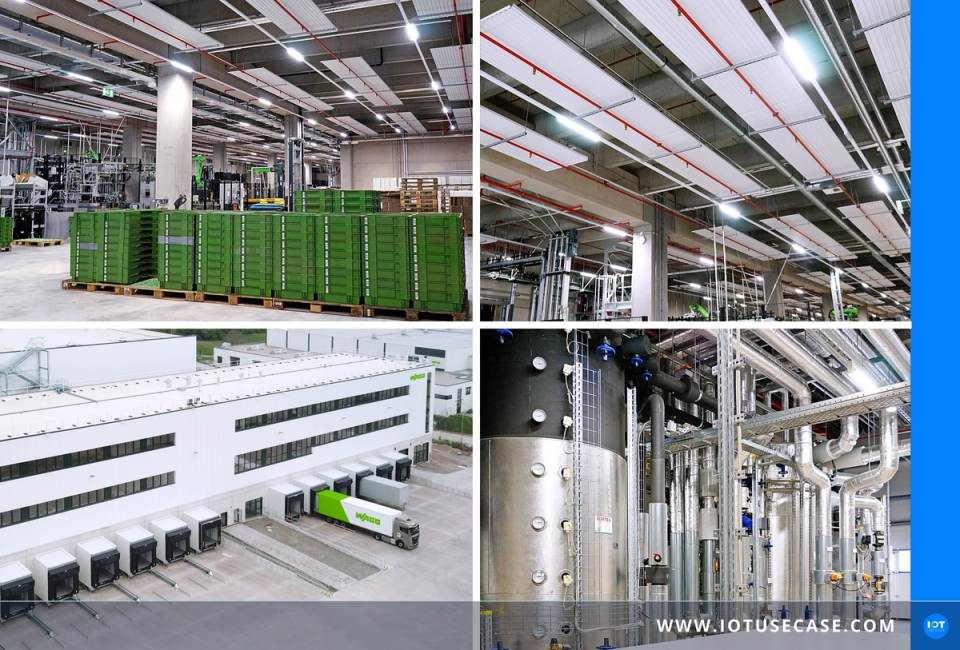
The new WAGO logistics center in Sondershausen (Thuringia) employs a fully electric energy concept based on continuous data acquisition and control. All technical systems—from the photovoltaic installation and heat pumps to the stratified thermal storage hydraulics and building automation—are designed to operate without fossil fuels and to allow their energy flows to be coordinated with one another during operation.
Unlike many industrial buildings, the energy concept was defined at a very early stage of planning as the basis for all technical decisions. Architecture, building services, and control systems were developed as an integrated whole to enable coordinated energy generation and consumption during operation.
The challenge: security of supply and energy efficiency without fossil fuels
Since 1991, Sondershausen has been an important industrial location and continues to grow steadily. As logistics capacities expand, so do the demands placed on energy supply and building services. In a fully electric logistics center, several factors converge to shape operations with complex load profiles:
- Dynamic load profiles resulting from intralogistics, conveyor systems, and building operation
- Additional consumers such as charging infrastructure for a fully electrified vehicle fleet
- Regulatory requirements arising from CO₂ reduction targets, Science Based Targets, and ESG reporting
- The elimination of fossil fuels while maintaining a high level of security of supply
Temperature control in storage and order-picking areas, variable utilization rates, seasonal fluctuations, and the integration of renewable energy generation place high demands on the coordinated interaction between energy sources and consumers. A photovoltaic system with volatile feed-in output makes coordinated control essential.
At the same time, pressure is mounting on companies and markets to use energy efficiently and to provide transparent evidence of consumption. Studies such as those conducted by the German Energy Agency show that savings potential of up to 35 percent can be realized through a structured energy management system—provided that decision-making is based on reliable data.
This level of data transparency must already be taken into account during the planning phase:
- Which combinations of generation and consumption are viable in the long term?
- How can peak loads be avoided?
- How can energy be managed in a way that maintains a balance between operations, user comfort, and economic efficiency?
For stable fully electric building operation with fluctuating loads, continuous data acquisition and control are essential to safeguard both energy supply and operational processes.
The solution: IoT-based coordination of generation, consumption, and building systems
At the Sondershausen site, a combination of renewable technologies was selected, with their interaction planned on a data-driven basis and optimized during operation. As early as the initial planning phase, the energy concept was modeled and simulated together with external partners, including Nordhausen University of Applied Sciences. Based on historical energy data from comparable sites, various scenarios involving photovoltaic systems, heat pumps, energy storage, and different operating strategies were analyzed. The results formed the basis for the design of generation systems, storage units, and transfer points.
Electrical supply for the new building is largely provided by a rooftop photovoltaic system with a total installed capacity of approximately 650 kWp. The thermal supply is handled by multiple air-to-water and water-to-water heat pumps, which support heating and cooling as required. Hydraulic decoupling with stratified thermal storage was planned in collaboration with Zortea Gebäudetechnik GmbH. This ensures stable temperature levels and supports efficient heat pump operation. Depending on the operating mode, primary energy demand savings of approximately 15 to 25 percent can be achieved.
The electrical implementation and integration of the planned energy and automation architecture were carried out in cooperation with Lübbing Elektrotechnik GmbH as the executing electrical and automation partner.
Beyond logistics operations, additional technical systems are integrated into the overall concept, including ventilation systems with heat recovery, air quality sensors and volume flow controllers, refrigeration systems, compressed air supply, safety-related systems such as sprinkler and fire detection systems, building lighting, and charging infrastructure for employee and fleet vehicles. Relevant parameters—such as occupancy, air quality, volume flows, and energy consumption at defined transfer points—are recorded and made available for control purposes.
Control of the technical infrastructure is implemented via WAGO's building and automation technology. Data from hydraulic systems, heat pumps, ventilation, lighting, charging stations, and other plant components are continuously collected, processed, and fed into the energy management system. On this basis, key figures such as primary energy demand, load shifting, and system efficiencies are calculated and evaluated over time.
Key IoT-supported applications include:
- KPI monitoring for heating and cooling to ensure stable operating conditions
- Load management to avoid energy-related peak demand periods
- An automated data foundation for energy controlling, replacing manual Excel-based data maintenance
The monitoring system is designed to meet both the requirements of internal energy management and the specifications for ESG reporting and future energy optimization measures. This includes, for example, the ability to reliably allocate CO₂ emissions by process zones and system areas.
The result: efficient, data-driven building operation without fossil energy
The new WAGO building in Sondershausen demonstrates how security of supply, energy efficiency, and climate strategy can be addressed in an integrated way. By relying on electrical energy and renewable generation, fossil fuels have been completely eliminated—the chimney is a thing of the past.
Building automation supports stable operating conditions for heating and cooling, reduces energy consumption, and provides a unified data foundation for energy controlling, management, and reporting. At the same time, the concept can serve as a reference for additional sites and construction projects within the company.
Overall, the result is a logistics center that dynamically adapts to real operating conditions and whose operation can be continuously optimized through ongoing IoT monitoring. The digital foundation is in place to integrate additional functions—from load management and on-site consumption optimization to energy price–driven operation or the simulation of supply risks.
The concept serves as a template for future new construction projects at WAGO.
Further information on this solution example – WAGO